Industrial process automation: how to connect the plant, data and AI with sound judgment
Industrial process automation does not start by choosing a platform or installing sensors. It starts by identifying a decision that today arrives late, depends on a spreadsheet or requires an operator to cross-check information from several systems. It might be deciding whether a batch should be put on hold, finding out why rejects have gone up, responding to a minor stoppage or reconciling what was produced with the production order.
We reply within 24 working hours
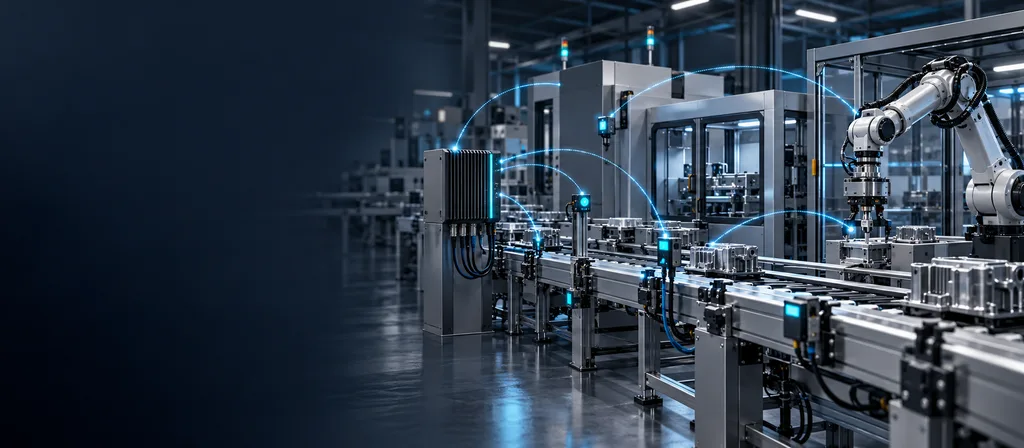
Industrial process automation: how to connect the plant, data and AI with sound judgment
In a real plant, the challenge is not only technical. There are constraints around safety, availability, machine cycle, quality, maintenance, traceability and shift work. That is why useful automation must respect the OT (operational technology) environment and, at the same time, turn plant data into information that maintenance, quality, production and management can use.
This guide explains how to approach that journey: from PLC and SCADA through to MES, ERP, edge and artificial intelligence. The goal is not to "digitize everything", but to build a maintainable system that reduces manual work and supports better decisions without putting production at risk.
What industrial process automation is, and what it is not
Classic industrial automation carries out a physical or logical action: regulating a temperature, moving a part, stopping a machine, dosing material or triggering an alarm. Industrial process automation widens that scope. It coordinates people, machines, data and business rules so that a whole process becomes more reliable, traceable and fast.
A project can include one or more of these layers:
- Field and control: sensors, cameras, readers, actuators, drives, robots and PLCs.
- Supervision: HMI, SCADA, process historians, alarms and recipes.
- Manufacturing operations: orders, batches, quality, traceability, maintenance and plant execution, often organized in an MES.
- Business: ERP, planning, purchasing, warehouse, sales and finance.
- Data and intelligence: operational dashboards, rules, anomaly detection, computer vision, predictive models and document assistants.
It is not a synonym for replacing people, nor for turning every signal into a dashboard. Automating well removes repetitive tasks, provides context at the moment of decision and makes it clear who can intervene, with what information and within what limits. An operator is still essential when the case is ambiguous, the cost of a mistake is high or the process knowledge needed has not yet been formalized.
Nor should it be confused with point-to-point integration. If every new need means writing a direct connector between two applications, the plant ends up with dependencies that are hard to diagnose. The solution must be able to explain which data was moved, when, from which piece of equipment, with which version of a rule, and what happened if the receiver did not respond.
Where the first profitable case usually is
The best first project is rarely the most eye-catching one. It is the one that meets three conditions: a frequent problem, a verifiable metric and data that can be obtained without needlessly disrupting the operation. Before thinking about AI, it is worth estimating the baseline over several weeks or shifts: how often the problem occurs, how long it takes to resolve and what it costs.
In-line quality and rejects
When visual inspection is repetitive, computer vision can check presence, position, dimensions, labeling, assembly or surface defects. But the camera alone does not solve the process. You need to define the lighting, optics, speed, product variability, tolerances, borderline samples and the cost of each error.
The important decision is a business one: what should the system do when it detects something? It can mark a part, divert a unit, stop the cycle, ask for human confirmation or open a non-conformance. It is prudent to start with an observation phase: the model classifies, its output is compared with the quality team's decision and its behavior is measured before an irreversible action is automated.
Automatic production capture and traceability
Writing down quantities, stoppages or batches on paper or in Excel creates delays and arguments about which figure is right. Connecting machine events to the order, product, batch, shift and stoppage cause lets you answer operational questions: what was actually produced, where a defect appeared, which parameters were active or which material was in process.
The value is not in piling up telemetry. It is in keeping the minimum context needed to investigate a deviation without rebuilding the history by hand. For example, a part counter is only useful for traceability if it is reliably linked to the right order and batch.
Alarms, micro-stoppages and incident response
Many sites have more warnings than one shift can deal with. Mature automation does not add yet another layer of notifications: it prioritizes, groups repeated alarms, relates the warning to the state of the order and presents the next safe check. It can also create a maintenance order, request a validation or record the resolution.
Micro-stoppages are a good example. Individually they seem small; added up, they reduce capacity and complicate planning. The first useful delivery is usually to classify and measure the causes, not to promise failure prediction from day one.
Condition-based maintenance
When there are stable signals (vibration, power consumption, temperature, pressure, cycles, quality of the output), it is possible to detect that a piece of equipment is drifting away from its normal pattern. A model or a rule can help prioritize the inspection, but it must not hide maintenance judgment or trigger control actions without proper validation.
Predictive maintenance needs historical examples, a well-recorded reference event and a precise definition of "failure" or "degradation". If work orders are closed without a cause or stoppage data is not standardized, it is more sensible to improve maintenance records first.
The architecture: from the signal to a decision someone can audit
A useful industrial architecture separates responsibilities. The PLC keeps deterministic and safe control of the machine. The supervision layer shows the process and the alarms. The data, integration and analytics systems consume information without becoming a single point of failure for the production cycle.
A simple representation looks like this:
Sensors / cameras / readers / actuators
                 ↓
PLC and machine control ── HMI / SCADA / historian
                 ↓
Gateway or edge service: normalizes, filters and stores events
                 ↓
MES / quality / maintenance / traceability  ↔  ERP / warehouse / planning
                 ↓
Analytics, rules, AI, operational dashboards and exception workflows
This separation reduces risk: a temporary outage of an analytics service should not stop a line by default. At the same time, it lets the upper layers evolve without reprogramming machine control every time a new report or document workflow is needed.
PLC, SCADA, MES and ERP: the role of each system
- PLC: controls the process logic and timing. It is the primary source for many states and signals, but it is not a historical business data store.
- HMI/SCADA: lets you supervise and operate equipment or processes, see alarms and, depending on the case, keep process history.
- MES: organizes the execution of manufacturing: orders, consumption, genealogy, quality, instructions and production capture. Not every plant needs the same MES scope; sometimes a specific workflow solves a particular problem first.
- ERP: holds the business view of materials, purchasing, sales, planning and accounting. It should receive consistent facts, not raw signals every second.
The OPC UA standard is designed to exchange information from sensors and control up to MES, ERP and enterprise services. More important than "having OPC UA" is agreeing on what the data means: what a state represents, how a line is named, when a counter resets and which source of truth applies to each field.
A robust interface needs clear contracts: asset identifier, timestamp, unit, data quality, schema version and how duplicate or late messages are handled. These decisions are less eye-catching than a dashboard, but they are what make it possible to trust one.
Edge or cloud: it is not a question of ideology
Industrial edge computing processes data close to the machine or the line. It is advisable when latency matters, connectivity is not guaranteed, video volumes are high, there are privacy restrictions or the operation must keep working on its own during a disconnection.
The cloud or the corporate data center is especially useful for consolidating information from several plants, training models, sharing documentation, managing users, integrating business systems and analyzing historical trends. In practice, many sound architectures are hybrid:
- At the edge, you capture, validate and process whatever needs a local response or operational continuity.
- On the central platform, you keep selected events, cross-reference them with business information and govern models, users and deployments.
For computer vision at the edge there are optimized inference tools, such as NVIDIA TensorRT, that integrate with certain devices and platforms. The decision should not be based only on advertised speed: you need to check power consumption, temperature, remote maintenance, spare parts availability, the lifecycle of the software image and how the system behaves when a camera or the network is disconnected.
The practical rule is simple: if a decision affects the production cycle, it is designed to work locally and in a degraded mode. If it is used to optimize, compare or learn at scale, it can be enriched in a central layer.
When industrial AI adds value
AI does not replace a data architecture or fix inconsistent naming. It adds value when there is a repeatable decision, representative data and a safe way to handle uncertainty. An academic review of AI in Industry 4.0 stresses precisely that integrating these systems involves data, integration and adoption challenges, not just choosing an algorithm (article on arXiv).
The most reasonable cases are usually:
| Case | Input | Useful output | Safeguard needed |
|---|---|---|---|
| Visual inspection | Image and product context | Defect class or verification | Human review for borderline cases and control of lighting |
| Anomaly detection | Process or energy series | Prioritization of a deviation | Do not mistake an anomaly for a causal diagnosis |
| Alarm classification | Alarms, states and incident text | Grouping, context and next action | History kept and validation by operations |
| Maintenance assistant | Approved manuals, history and assets | Guided search and draft action | Role-based access; never replace safety procedures |
| Parameter optimization | Stable process, quality and constraints | Recommendation for the engineer | Physical limits, controlled tests and traceability of changes |
A good question for filtering ideas is: if the model gets it wrong, what happens and how do we detect it? If the answer involves risk to people, regulated quality or damage to equipment, the model must be assistive or go through explicit approval. Automating the action comes after precision, robustness and rollback procedures have been demonstrated.
OT cybersecurity: availability is also security
In industrial environments, patching, scanning or restarting cannot be treated the same way as on an office network. The NIST SP 800-82 Rev. 3 guide describes this difference: operational technologies have their own performance, reliability and physical safety requirements, in addition to the usual confidentiality and integrity ones.
An automation project must build in security from the design stage:
- Inventory of assets, versions, owners and network dependencies.
- Segmentation between OT zones, edge services and corporate systems; least access needed.
- Named accounts, strong authentication for remote access and activity logging.
- Certificate management and encrypted channels where the protocol and the equipment allow it; OPC UA includes authentication, encryption and auditing mechanisms.
- Verified backups of PLC, HMI, server and model configurations; an untested backup is not a recovery plan.
- Change windows, prior testing and a clear procedure for rolling back.
Security is not a checklist added before going live. It is a design condition that determines which data can leave the plant, who can send commands and what happens when a component fails.
A pilot that produces evidence, not a demo
A well-designed pilot reduces technical and operational uncertainty. It must run under real conditions, with the operators and data that will be used afterward. Showing a camera with perfect parts on a table is not validating an in-line inspection.
1. Define the problem and the owner
Formulate a concrete hypothesis: "reduce the time from a quality alarm until the cause is assigned", or "stop an incorrect label from leaving a station". Name an owner from production or quality, not just a technical lead. Also agree which result would mean the pilot does not continue.
2. Measure the baseline and the exceptions
Gather current performance, the number of incidents, response times, manual review rate and approximate cost. Document the rare cases: format changes, out-of-spec product, cleaning, the night shift, network loss and maintenance. Edge cases are part of the requirement, not a surprise later on.
3. Connect non-intrusively
Whenever possible, the pilot starts by reading signals and events without modifying control. Names and timestamps are normalized, data quality is checked and the flow is logged. If writing to a system will be needed in the future, that authorization is introduced explicitly and in stages.
4. Validate with the plant team
In vision, a representative sample is labeled and training and test data are kept separate. In alarms or maintenance, the recommendations are compared with the technicians' assessment. An overall metric is not enough: you have to examine the errors that matter, for example false negatives on a critical defect.
5. Decide with business and operational metrics
At the end of the pilot, compare against the baseline and answer: was a wait, a reject, a repeated task or investigation time reduced? Did the system keep working through the expected incidents? Who will provide support, update rules and review the model? Deciding to scale is just as valid as discarding a hypothesis if the results do not justify it.
How to calculate the return without inventing percentages
Generic ROI percentages rarely help. The calculation must start from the plant's own data. For a quality case, a useful formula is:
estimated annual benefit =
  (rejects avoided × unit cost of a reject)
  + (manual hours freed up × loaded hourly cost)
  + (stoppages avoided × margin or opportunity cost per hour)
  - recurring operating costs
Incompatible benefits must not be added together. For example, a rejected part cannot count both as recovered production and as a full saving if it ends up being reworked. You also need to include cameras, installation, integration, validation, support, licenses, connectivity, training and internal team time.
As a reference for how an initiative should be tied to observable results, the Toyota Industries case describes a pilot that unified process data to investigate paint defects; the company later reported concrete results from its own implementation. It is a case for context, not a transferable promise: the baseline, data maturity and process of each factory are different.
The right indicators depend on the case, but they usually include:
- time to detection, response and resolution;
- defect rate, rework and quality escapes;
- minutes of downtime and the distribution of causes;
- adherence to procedure and completeness of traceability;
- percentage of decisions that require human review;
- availability and quality of the automation system itself.
Common mistakes to avoid
Starting with the AI model. Without a defined process, labeled data and a clear action, the result is a demo that is hard to take into production.
Sending every signal to the ERP. The ERP needs consolidated, meaningful events; it does not replace a process historian or a high-frequency event layer.
Changing the control logic too early. First observe and validate. Then, where appropriate, automate actions with limits, permissions and a way to roll back.
Ignoring the operators. They are the ones who know the exceptions, format changes and conditions that do not appear in a diagram. Their involvement turns a technically correct solution into a tool that actually gets used.
Not assigning ownership of the system. A project needs owners for the process, data, cybersecurity and maintenance. Without them, nobody knows who reviews a faulty alarm, updates a recipe or approves a model change.
How DPI Systems can help
At DPI Systems we design and implement industrial automation and control solutions starting from the process and the plant's constraints. We can help prioritize cases, connect equipment and applications, deploy edge processing, build computer vision for quality control and integrate the results with traceability, maintenance or ERP systems.
The approach is incremental: assess the process, confirm the available data, run a pilot with acceptance criteria and prepare the roll-out with security, support and metrics defined. The aim is for the technology to become part of day-to-day operations, not to depend on an isolated demo.
If you want to assess a specific case (quality, traceability, alarms, maintenance or integrating the plant with the business), DPI Systems can carry out an initial technical and operational assessment.
Sources and further reading
- NIST SP 800-82 Rev. 3: Guide to Operational Technology Security.
- OPC UA Part 1: Overview and Concepts and an overview of OPC UA security.
- Artificial Intelligence in Industry 4.0: A Review of Integration Challenges for Industrial Systems.
- NVIDIA TensorRT Installation Guide.
- Toyota Industries case on plant data and quality.
Frequently asked questions
Not necessarily. Many projects start by reading information from the existing equipment through available interfaces, gateways or integration layers. Feasibility depends on connectivity, the state of the systems, security and the level of access that has been authorized.
SCADA supervises and operates the plant process; MES organizes the execution of manufacturing and its traceability; ERP manages planning and business processes. The boundaries between them change from one organization to another, but it is worth assigning a single source of truth to each piece of data.
Rules are preferable when the condition is known, stable and explainable. AI makes sense when there are complex patterns (for example, images or signal series) that cannot be expressed well with fixed rules. In both cases there must be limits, validation and supervision.
No. Processing can take place at the edge or on local infrastructure when latency, connectivity, privacy or corporate policy require it. A hybrid architecture lets you keep decisions local and centralize only the information that is needed.
It depends on the case, access to data and the validation criteria. It is better to define the scope, the metric and the test conditions before setting a date. A short but representative pilot provides more evidence than a large project with no baseline and no owners.
Find out where it can make an impact
At DPI Systems we approach the project from the business process through to the technical integration. If you want to find out where industrial automation could make an impact in your plant, ask us for an initial assessment.